Common, striped and bottlenose dolphins: how to tell them apart
8 min read
Three dolphins share the Alborán Sea and the Strait of Gibraltar, and they are easy to confuse from a boat: the common dolphin, the striped dolphin and the bottlenose dolphin. This guide sums up what the official factsheets of Spain’s Ministry for the Ecological Transition (MITECO) and the IUCN say about each species, so you know what to look for and what each conservation category means.
A reminder before we start: these are wild animals and no operator can guarantee you will see them. For how a boat should behave when they are close, read our guide to the rules for watching dolphins.
The three species at a glance
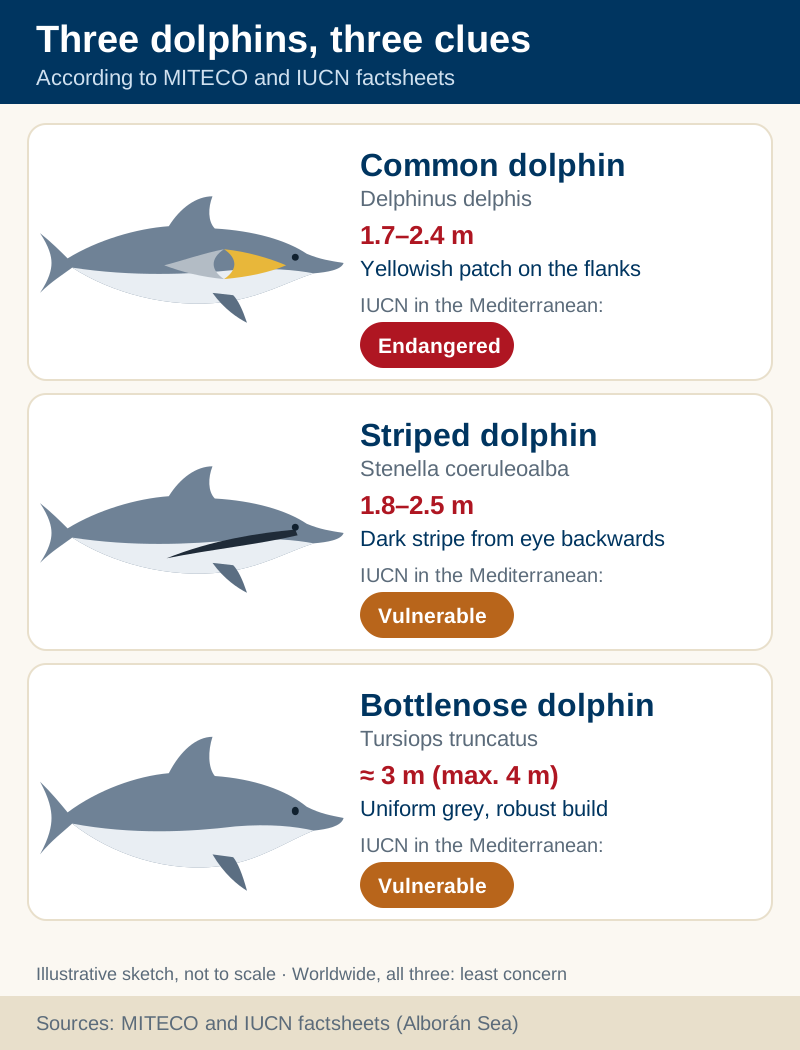
| Common dolphin | Striped dolphin | Bottlenose dolphin | |
|---|---|---|---|
| Scientific name | Delphinus delphis | Stenella coeruleoalba | Tursiops truncatus |
| Size | 1.7 to 2.4 m | 1.8 to 2.5 m (average about 2 m) | The largest of the three: average about 3 m (maximum 4 m) |
| Key feature | Yellowish patch on the front of the flanks, shaped like a figure eight, an hourglass or a cross | Dark stripe running from the eye backwards, past the middle of the body | More or less uniform dark grey with a white belly and a robust look |
| Groups | 1 to 500; usually about 30 or fewer | 1 to 500; in Alborán, sometimes several hundred | Typically 2 to 25; in Alborán, average 25 and up to a little over a hundred |
| Habitat | Near and far from the coast | Prefers deep water, beyond the continental shelf | Continental shelf and also deeper water |
| IUCN, worldwide | Least concern | Least concern | Least concern |
| IUCN, Mediterranean subpopulation | Endangered | Vulnerable | Vulnerable |
Measurements are approximate and vary between individuals. Each fact is attributed to its factsheet in the sections below.
How to read the conservation categories
All three species are «least concern» worldwide, but the IUCN also assesses the Mediterranean subpopulations, and there the picture is worse. That is why you often see two different classifications for the same species: they do not contradict each other, they refer to different scopes. In this article we always say which one each category refers to.
Common dolphin (Delphinus delphis)
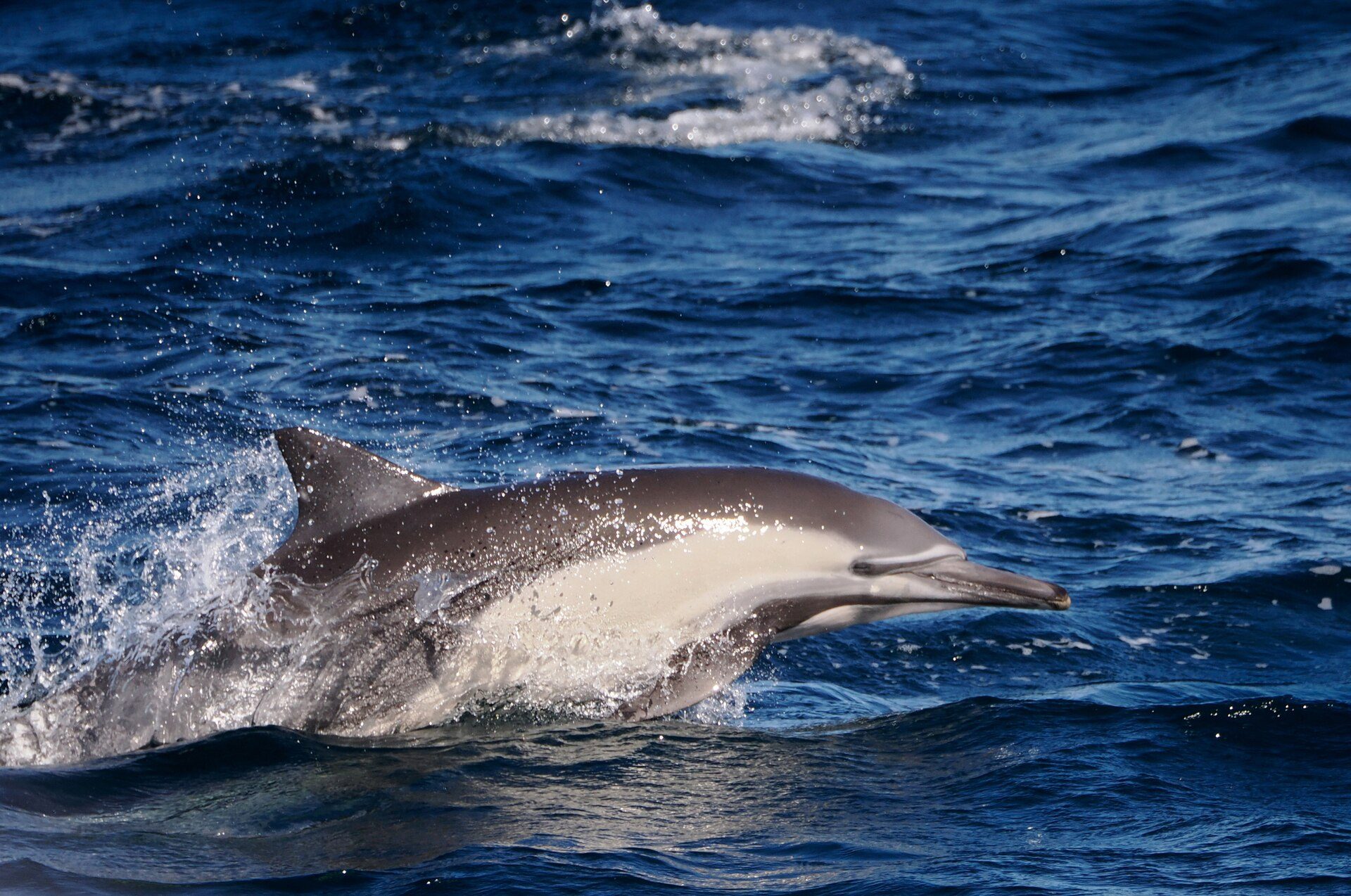
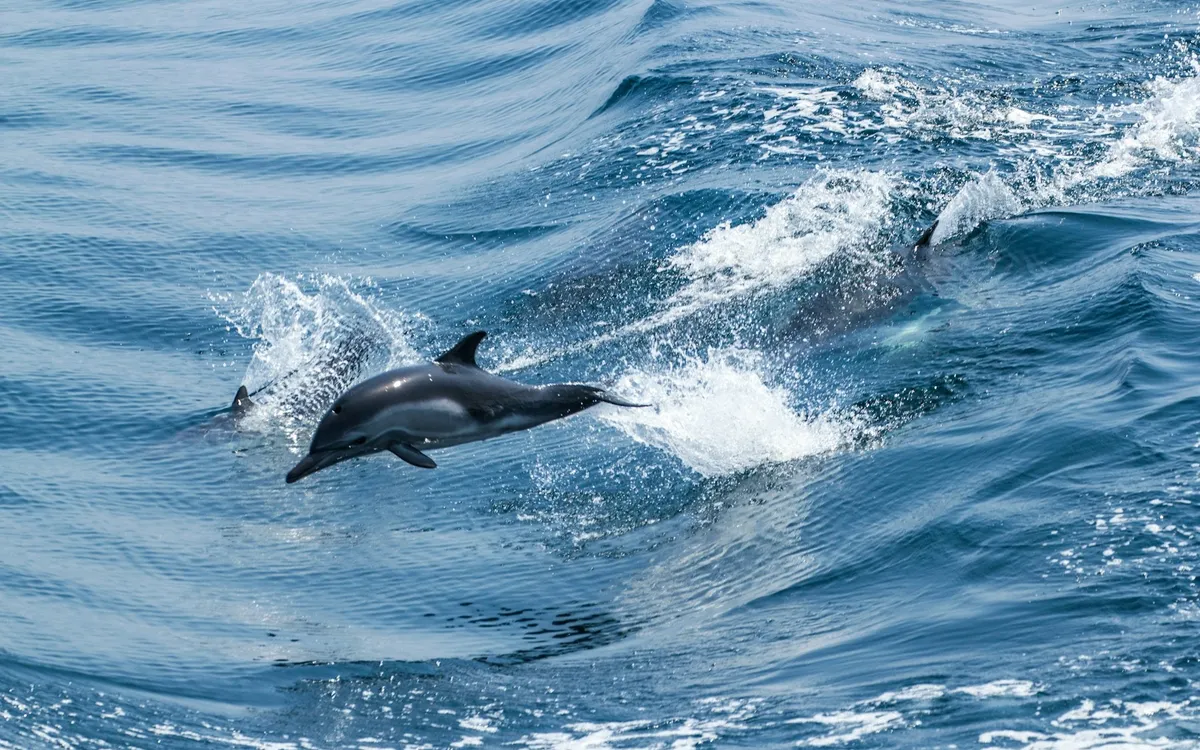
According to the MITECO factsheet, it is a small, very sociable dolphin with a dark grey to brown back and a pale belly. Its most useful identification feature is the yellowish patch on the front of the flanks, with a pattern that recalls a figure eight, an hourglass or a cross. It lives near and far from the coast, forms schools of one to five hundred animals (usually about thirty or fewer) and is very active at the bow of boats.
The IUCN factsheet on the Alborán Sea adds that this is the part of the Mediterranean with the highest densities of the species and that there «it is easy to see groups of several hundred animals». Even so, the Mediterranean subpopulation is classified as «Endangered» after a decline of more than 50 % in recent decades. The main threats are accidental capture in nets, overfishing of its prey and pollution.
Striped dolphin (Stenella coeruleoalba)
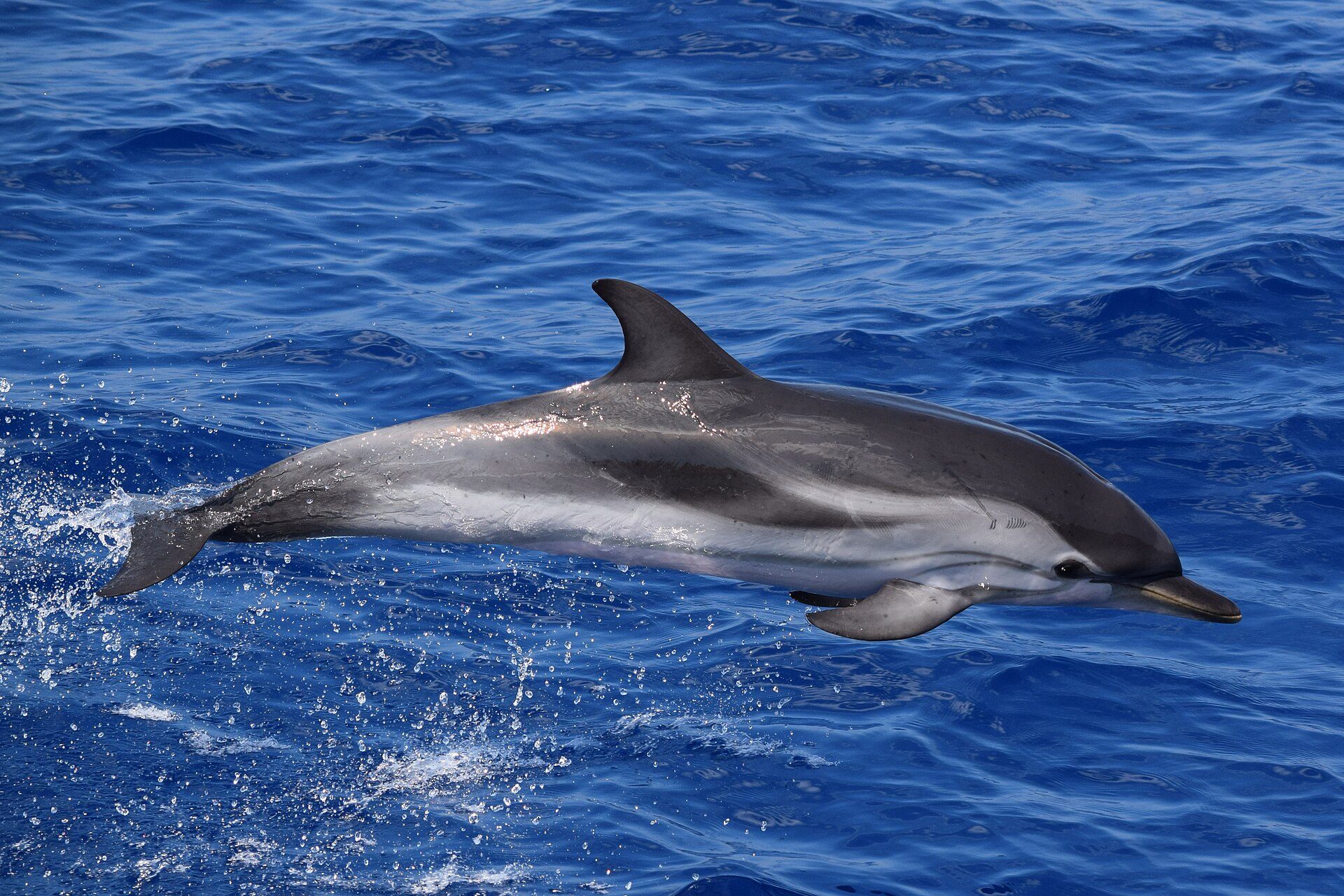
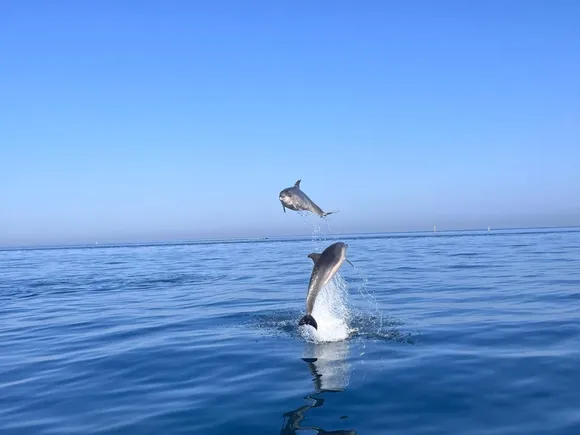
What sets it apart is the dark stripe: it starts at the eye, runs backwards and drops towards the belly. The flanks are light bluish grey with a pale band rising towards the dorsal fin, and the back ranges from dark grey to almost black.
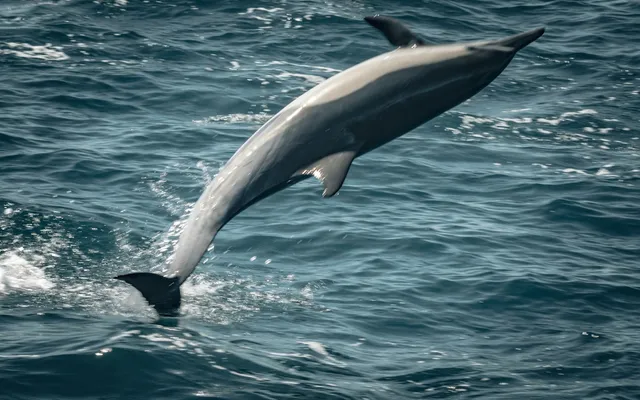
According to the IUCN, it is the most abundant cetacean in the Mediterranean, although not evenly spread: it prefers deep water, beyond the continental shelf. In Alborán it is easy to find groups of several hundred. The MITECO factsheet notes that some of its features are only clear when the animal leaps. Its Mediterranean subpopulation is listed as «Vulnerable» (a decline of over 30 % in 60 years, due to viral diseases, accidental capture and pollution). In Spain it is on the List of Wild Species under Special Protection, but not in the Spanish Catalogue of Threatened Species.
Bottlenose dolphin (Tursiops truncatus)
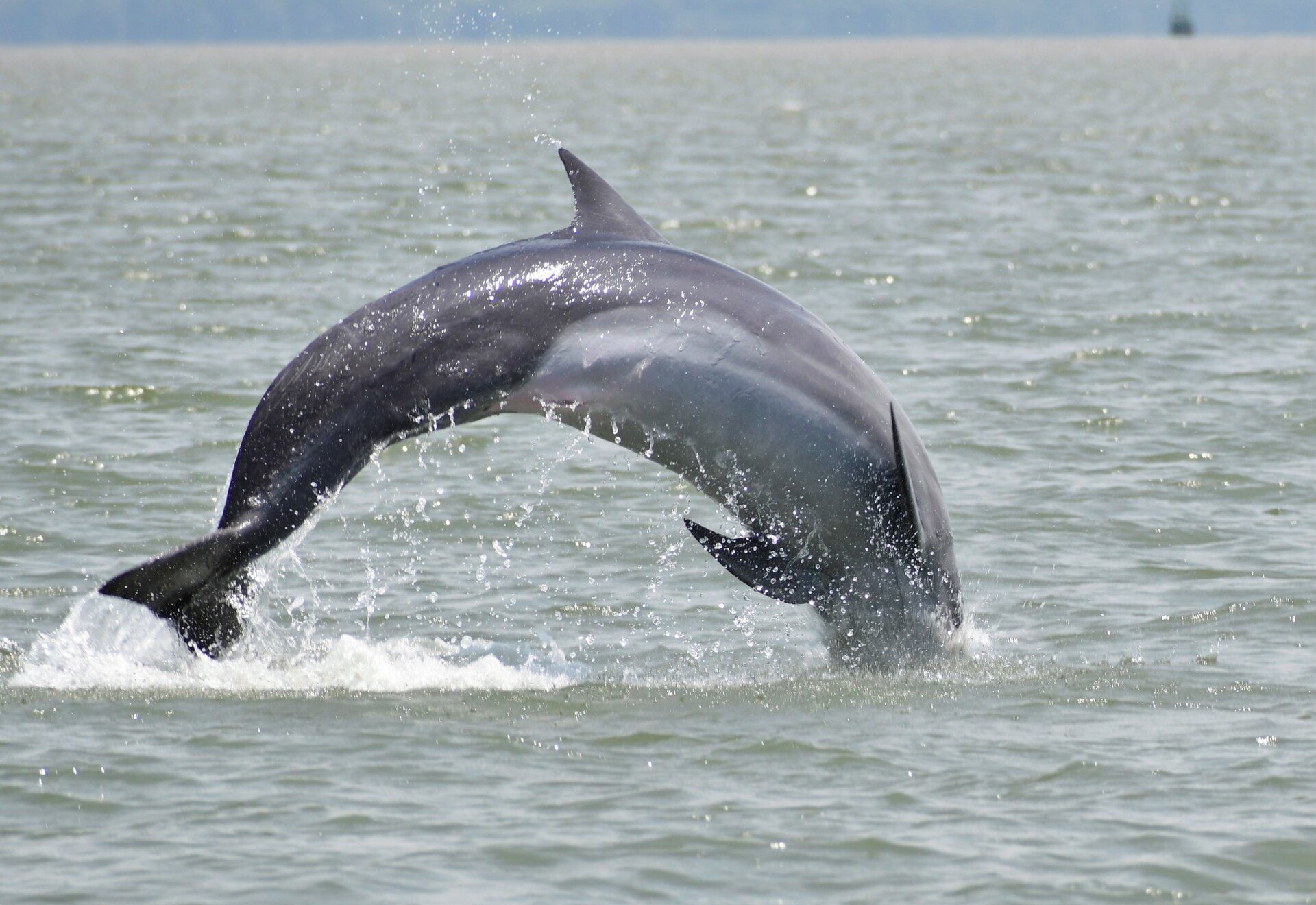
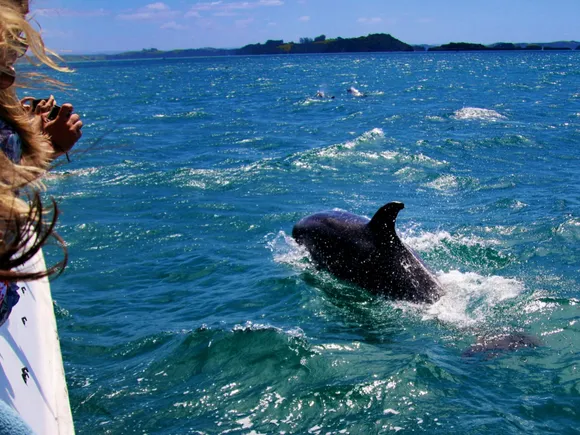
It is the stockiest: more or less uniform dark grey, a white belly and a «rather robust» look compared with other small cetaceans. There are two morphotypes, the coastal (considerably smaller) and the pelagic, and the IUCN says that in Alborán mostly the pelagic type appears to occur. In the Strait it frequents waters between 200 and 600 m deep.
Alborán has the largest group sizes of the whole Mediterranean: an average of 25 animals and up to a little over a hundred. Its Mediterranean subpopulation is «Vulnerable» for the IUCN (a decline of over 30 % in 60 years) and the species is «Vulnerable» in the Spanish Catalogue of Threatened Species. The main threat is accidental capture in fishing gear.
It is also the best-studied species on the Málaga coast: a photo-identification study between Torremolinos, Benalmádena and Fuengirola counted 210 sightings between May and October and 79 different individuals (Chronica Naturae, 2016).
Tips for recognising them from the boat
- Size and build. A large, robust animal of uniform dark grey points to a bottlenose.
- The dark eye stripe. If you can see the flank well and a dark line runs from the eye towards the belly, it is a striped dolphin.
- The yellowish pattern. A figure-eight, hourglass or cross-shaped patch on the front of the flanks indicates a common dolphin.
- Numbers. Groups of tens or hundreds are usual for common and striped dolphins; bottlenose usually travel in smaller groups, although in Alborán they can exceed a hundred.
- Behaviour. Common dolphins readily approach the bow of boats.
These are only guidelines: all three can be seen in the same area and sometimes mixed, and scientists use photo-identification to confirm the species.
Seeing them in motion
Two videos from a conservation organisation and an institutional tourism body. A video only loads when you press «play»; until then nothing connects to YouTube.
Which one are you most likely to see?
There are no official sighting statistics per trip, so we cannot give you a probability. What the sources do document:
- In the Alborán Sea, the common and striped dolphins are cited as very abundant (IUCN).
- On the Málaga coast, the bottlenose was the most sighted in one particular study (Torremolinos–Fuengirola, 2015).
- In the Strait, published studies describe the common, striped and bottlenose dolphins as resident, together with the long-finned pilot whale (Revista Almoraima).
A conservation note
Watching cetaceans is regulated in Spain: there are minimum distances and limits on speed and on the number of boats. The better you can tell them apart, the easier it is to respect them. Choose an operator that follows the rules and does not ask to get closer than allowed.
If you would like to see them in their element, we sail from Sotogrande and Estepona: have a look at our dolphin-watching trips and the guides to Sotogrande and Estepona. And if the orcas of the Strait interest you, read our guide to the Iberian orca.
Frequently asked questions
Which dolphin is seen most in the Alborán Sea?
According to the IUCN, the common and striped dolphins are very abundant there and often seen in groups of several hundred. On the Málaga coast, a 2015 study recorded the bottlenose as the most sighted.
How do I tell a bottlenose from a common dolphin?
By build and colour: the bottlenose is larger and more robust, uniform dark grey with a white belly; the common dolphin is smaller and has the yellowish patch on the front of the flanks.
Are they endangered?
It depends on the scope. Worldwide, all three are «least concern». The Mediterranean subpopulations are in a worse position according to the IUCN: «Endangered» for the common, «Vulnerable» for the striped and «Vulnerable» for the bottlenose. The bottlenose is also «Vulnerable» in the Spanish Catalogue of Threatened Species.
Can I see all three on the same trip?
It is possible, but it cannot be guaranteed. The sources say all three live in the area; which species appears on a given day is unpredictable.
Sources
- MITECO · Factsheet on Delphinus delphis (common dolphin), updated 2015 (Spanish).
- MITECO · Factsheet on Stenella coeruleoalba (striped dolphin) (Spanish).
- MITECO · Factsheet on Tursiops truncatus (bottlenose dolphin) (Spanish).
- IUCN · Alborán Sea factsheets: common, striped and bottlenose (Spanish).
- Chronica Naturae 6 (2016) · Photo-identification catalogue of the bottlenose dolphin in Torremolinos, Benalmádena and Fuengirola (Spanish).
- Revista Almoraima · study on cetaceans of the Strait (Spanish).
- Photos: steve b (CC0), Wanax01 (CC BY-SA 4.0) and Juan Romero (CC BY-SA 4.0), via Wikimedia Commons. Infographic: our own work based on the factsheets.
Last checked: 26 October 2026. The IUCN factsheets do not state a publisher or date in their text; the MITECO ones have different dates (the common dolphin’s is from 2015). Conservation categories may have been revised since.